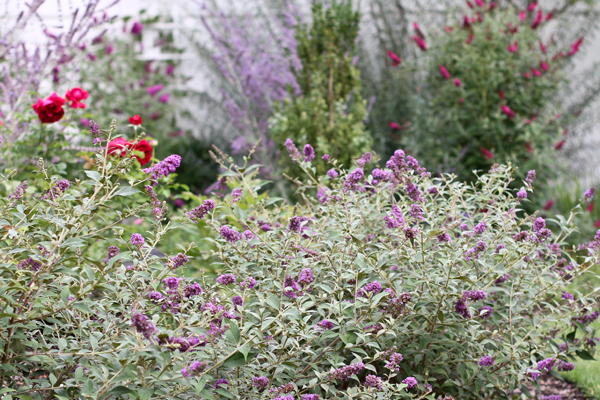
Today I write about the four types of butterfly bushes (Buddleia) in my grarden. Butterfly bushes are great for late summer color, and they really do attract crowds of butterflies, hummingbirds, and fuzzy bumblebees. Above is 'Buzz Purple,' with spikes of 'Caradonna' salvia in front (on its second flush of bloom for the year) and an overgrown dwarf Arctic willow in back. Can you believe I cut that willow back to the ground this spring?

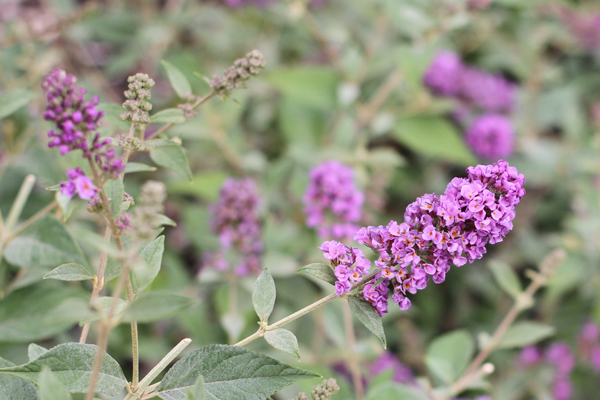
Here are the flowers of 'Buzz Purple' up close. All the Buzz butterfly bushes - there are other colors available - are supposed to stay dwarf at 2-3 feet tall and wide, but mine has grown to about 5 feet tall and 4 feet wide this summer. Four to five feet is still smaller than the old cultivars that grew 8-10 feet.My climate is so cold that all the butterfly bushes die back to the ground each year, so in warmer climates I bet this shrub would grow even larger. Of course you can control the size no matter where you live by cutting the bushes down to the ground each spring. The nice thing about this series is that they have very little reseeding, unlike older cultivars which could be invasive.

Above is 'Miss Molly,' a Proven Winners selection that is supposed to grow 4-5 feet tall and 5-6 feet wide with no reseeding. Both of mine grew that tall but stayed really skinny this summer. I'm not sure if that's what they will do every summer or if this odd shape is due to specific climate conditions. I'll have to wait until next year to see.
'Miss Molly' is advertised as the reddest butterfly bush available, with the red color more pronounced in warmer climates. I have noticed the flowers that open during hot spells are more red than the ones that open during cooler times.
I planted this 'Miss Ruby' bush earlier this summer, so it hasn't had time to grow to its full size. Its color is a softer, cooler pink than 'Miss Molly,' though its predicted size is the same as MM. Butterfly bushes are hardy in zones 5-9 and prefer full sun and well-drained soil. They are supposed to be deer resistant as well.
Here you see the flowers of 'Miss Ruby' up close, with a dying spike of flowers at the bottom. Eventually the bloomed-out flower spikes fade to black. They don't look awful if you don't get around to deadheading, but the shrubs do look better if they are regularly deadheaded.
My final butterfly bush is 'Blue Chip' from the Proven Winners Lo and Behold series. This type has actually stayed dwarf through several seasons, growing to about 2 feet tall and wide. I have 6 of these in the backyard and they haven't reseeded, as promised.
The color of 'Blue Chip' is less flamboyant than the other bushes in my garden, and the butterflies seem to prefer the shrubs with brighter colors. But I still see a few butterflies and hummingbirds on this type.
This summer I have enjoyed cutting flower spikes from the butterfly bushes to use in floral arrangements. They last several days in a vase and work really well with my English Roses. That is yet another reason to find a spot for a butterfly bush in the garden, especially with these newer, smaller, noninvasive cultivars available.