May 9, 2018

Spring Petal Shower


The 'Royal Raindrops' crabapple trees are coming into bloom this week as the 'Spring Snow' crabapples drop their petals.  I have been busy in the garden with all the spring chores.  It's so nice to be outside again after a long winter.

Creeping phlox and Euphorbia polycroma add color at ground level along with a few tulips.

Long blooming 'Margarita' tulips are finishing up as 'Black Hero' begins to open.  I really need to plant more tulips this fall!

By fall I have less energy for planting bulbs, but in spring I always wonder why I didn't plant many more of them.  In this main sunny bed, I'm planning to add more double tulips for next year, like 'Orange Princess,' 'Abba,' 'Miranda,' 'Black Hero,' and 'Menton Exotic.' 


Allium leaves have been providing green color for over a month, and the earliest allium bloomers are starting to open their buds.  My alliums increase each year and have been divided and transplanted around the garden.


On warm days we've been enjoying the new bench swing.  Soon this corner will be shady when the honey locust trees finally finish leafing out.


My six 'Katherine Havemeyer' lilac shrubs are blooming now.  I wish I'd planted six different types instead, but in the past couple of years I found space for deep violet 'Yankee Doodle' and reddish-purple 'Charles Joly.'  These aren't blooming yet.  Maybe next year.


I planted annual verbena, euphorbia and dichondra in the bottom section of my broken black fountain.  The sprinklers reach it, though I might have to supplement water in the hottest part of summer.


I'm happy to finally look out the window and see so much green.


May is a magical time in the garden.  There's even more color coming next month, but I have to remind myself to fully enjoy what's happening now.


The west garden is cheerful as usual.  Spring is so great. 

April 17, 2018

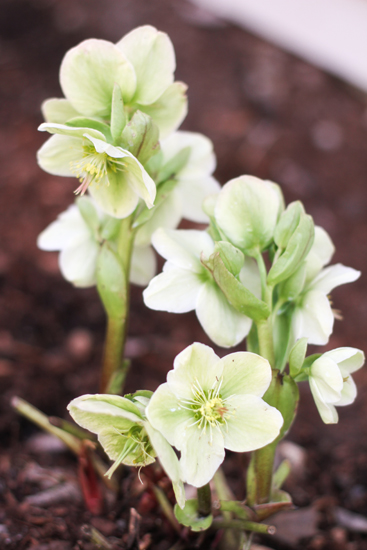
Hellebore Roundup for GBBD


Other plants than hellebores are blooming in my garden, including small bulbs like windflower anemones and scilla, but hellebores like 'Kingston Cardinal,' above, have the largest presence.

I now have about fifty hellebore plants, thanks to division and seedlings.  The 'Golden Lotus' plant above was carefully cut into three divisions with a serrated kitchen knife and replanted in other areas. 


This double white was a seedling that matches my 'Sparkling Diamond,' so that's what I'm calling it.  The original plant was attached by a black fungus last spring and hasn't fully recovered, though it sent up one bloom stalk this year.

This seedling seems to be a mix of red 'Velvet Lips' and 'Pink Tea Cup,' and I'm proudly calling it 'Strawberry Freckles.' 


'Velvet Lips' also produced three true-to-form seedlings that bloomed for the first time this spring.  I cut apart my other plants and now have eight plants in total, six of which are planted in the northwest corner. 


This unnamed white hellebore was also divided into three plants and transplanted around the east back bed.   


Some of my large plants didn't bloom well this spring after their buds began growing during a warm spell in February (we reached 60 degrees F one day), then the temperature plummeted to zero the next week and turned the buds to mush.  This 'Golden Lotus' was one of the heavily hit plants, but the leaves are growing well so it should recover for next year.

'Jade Tiger' also lost its flower buds to the cold snap, but its leaves are beautiful on their own.  They'll lighten to green later in the seasons.

A few newly planted hellebores are blooming, including 'Sweetheart Ruffles' above.

One bloom stalk on a baby 'Molly's White' is blooming.  The leave are supposed to be frosted with silver, so I'm looking forward to seeing them.  None of my baby 'Wedding Series' hellebores bloomed this spring, but there is a tiny bud on one of my newly planted 'Madame Lemmonier' plants. 


'Amber Gem' bloomed for the first time, and it's not quite the color I imagined.  That happens sometimes with seed-propagated hellebores, though the tissue-propagated plants are all identical.


And 'Pink Tea Cup' is still going strong in the front yard.  It will be several years before all my baby plants and small divisions reach this size, but then the early spring show will be wonderful.  As much as I love spring bulbs, they don't stay in bloom for very long.  It's very nice to have hellebores that bloom for several months each year. 
I'm a little late for Garden Bloggers Bloom Day (though I got my taxes done on time!), but thanks to Carol at May Dreams Gardens Blog for reminding us to take stock of our flowers each month.

April 13, 2018

Privacy in Suburbia


In my last post I wrote about using columnar shrubs and trees for privacy.  I want to continue on that topic since privacy in the yard has been on my mind a lot lately.  At this time of year I want to be outside working in the garden, but I feel very exposed since the trees haven't leafed out yet.  I have mentioned before that I can see parts of sixty-three houses from various points in my backyard.  This is the view of my NW corner from my bedroom window, and you can see quite a few of the neighboring homes in the scene.  I'm usually careful to crop the photo of this view, but here is the full disclosure.  However, the columnar Norway spruce at left will eventually block the view of Santa (from my previous post) on the neighboring rooftop.  Supposedly it can reach 20' tall and 5-6' wide in ten years.  Grow, baby, grow!


From ground level, one neighboring home is still very apparent at this time of year.  Thankfully these neighbors have planted quite a few trees in their yard to help screen the view.  When my columnar Norway spruce and their blue spruce (to the right of this shot) are mature, they will block part of the view between our houses year-round.  The thicket of deciduous branches at center will get thicker as time goes by and eventually provide decent screening.


The view of the same area from another angle features another neighboring home.  Again, my thicket of deciduous branches ('Royal Raindrops' crabapple trees) and two maples planted over the fence will block more of the view in coming years.  These neighbors have an oak tree planted in their yard that will also contribute to the thicket of branches in ensuing winters.  Slowly, this view will be mostly blocked.


The winter screening in my NE corner (viewed from my window) isn't going to get much better than this.  The honey locust trees leaf out late and drop their leaves early.  Their branches will thicken somewhat, but not enough to really block the view of the neighboring white house and the items that are usually stored on their back deck.  That house had a flowering plum tree planted in their neighboring corner when I planned my landscape, but the tree has since died.


Now that my backyard garden has year-round interest, I like looking out my window every morning and evening.  In winter the snow makes a lovely addition to the bare branches, evergreens and boulders.  I'd like the view to include fewer neighboring houses so I can focus on what's happening in my yard.


Here is the NE corner from ground level.  The trees across the fence are mostly quaking aspens, which leaf out early and drop their leaves later than my honey locusts.  On a side note, our new bench swing is wonderful to sit on but is shockingly bright white.  Hopefully it will get a little dirty in time and blend better with our dirty white fence, ha.


This shot of the NE corner from farther back inspires me with how much screening a thicket of bare branches (lilac, crabapple and honey locust) can provide.


In the very corner of my NE area, a 'Shasta' doublefile viburnum is filling the space as it matures.  A 'Shademaster' honey locust is planted eleven feet from the corner, and three 'Green Mountain' boxwoods are growing on either side of the viburnum.


There is not enough space to plant evergreens (columnar Norway spruce or even Arborvitaes) unless I rip out the viburnum.  I don't have another spot in the yard with enough space for that large shrub (10-12' wide at maturity), and I'd be sad to lose it completely.  But dogwood trees are understory trees in the forest.  They grow underneath other trees and close together.  I'm tossing around the idea of snugging two 'Starlight' dogwoods on either side of the viburnum, next to the boxwoods.  I'd have to plant them right next to the fence and plan to prune off lower branches to leave room for the viburnum and fence.  But eventually the thicket of branches above the fence would provide more screening for this area, plus the dogwoods would bloom and leaf out a month before the honey locust.  I could increase my dogwood total to seven trees, which is always a good thing.  Would I rather have this corner a little crowded but more private?  Yes.  Do I mind pruning?  No.  Hmm, this idea has merit.  I'm going to mull it over a little more.


I'll finish with this shot of the SE corner of my yard.  A dogwood planted across the fence in my front yard will someday screen the neighboring windows a little better.  Building privacy with trees in a climate with a short growing season requires patience.  I wish I had done a better job of planning for privacy a decade ago, but better late than never, eh?